
Accelerating Phase Diagram Prediction by Machine Learning Potentials
Author:Zhang Wenhao
Affiliation:ICYS, National Institute for Materials Science
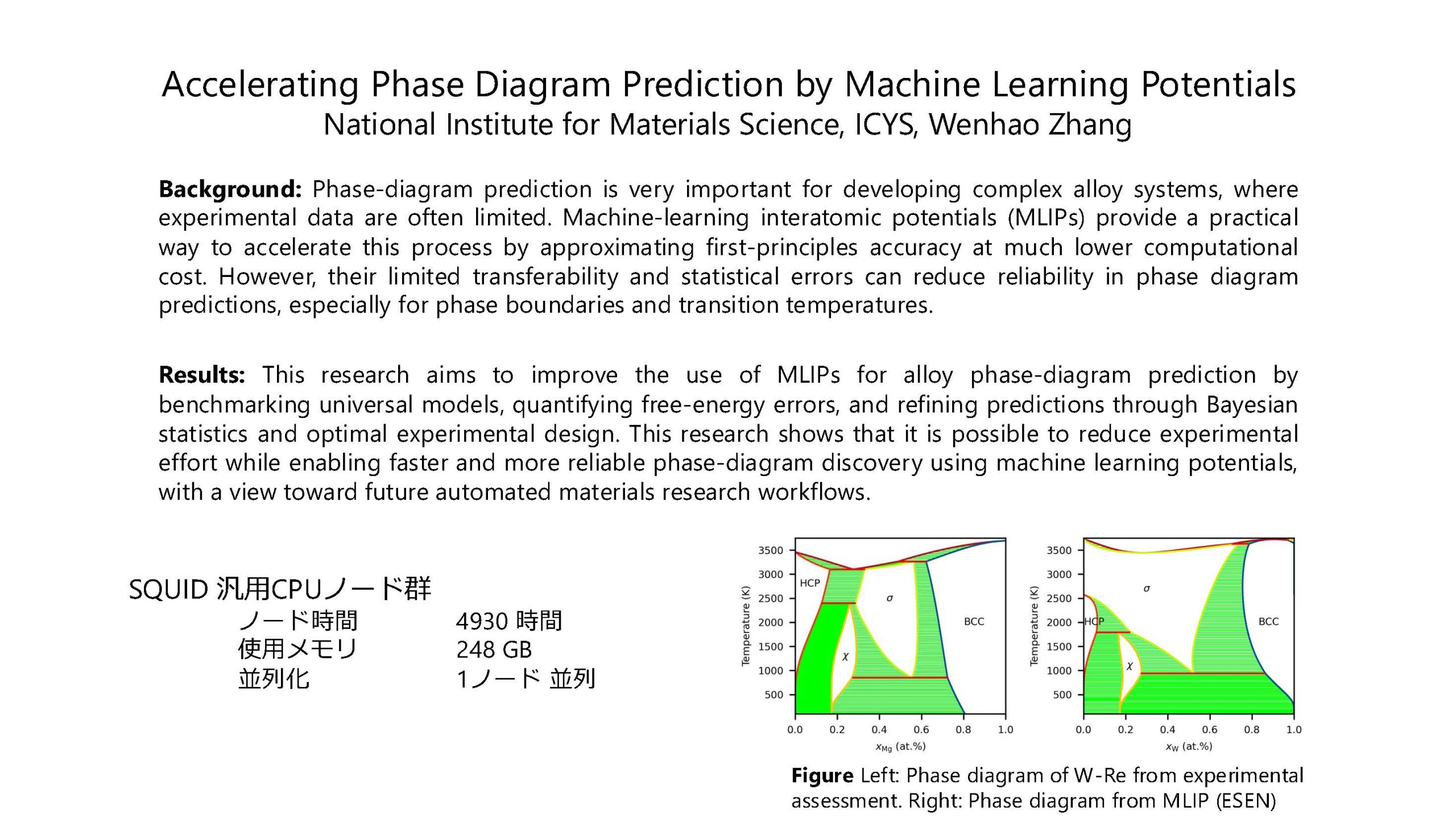
Abstract:Phase-diagram prediction is very important for developing complex alloy systems, where experimental data are often limited. Machine-learning interatomic potentials (MLIPs) provide a practical way to accelerate this process by approximating first-principles accuracy at much lower computational cost. However, their limited transferability and statistical errors can reduce reliability in phase diagram predictions, especially for phase boundaries and transition temperatures. This research aims to improve the use of MLIPs for alloy phase-diagram prediction by benchmarking universal models, quantifying free-energy errors, and refining predictions through Bayesian statistics and optimal experimental design. The overall goal is to reduce experimental effort while enabling faster and more reliable phase-diagram discovery, with a view toward future automated materials research workflows.
Affiliation:ICYS, National Institute for Materials Science
Abstract:Phase-diagram prediction is very important for developing complex alloy systems, where experimental data are often limited. Machine-learning interatomic potentials (MLIPs) provide a practical way to accelerate this process by approximating first-principles accuracy at much lower computational cost. However, their limited transferability and statistical errors can reduce reliability in phase diagram predictions, especially for phase boundaries and transition temperatures. This research aims to improve the use of MLIPs for alloy phase-diagram prediction by benchmarking universal models, quantifying free-energy errors, and refining predictions through Bayesian statistics and optimal experimental design. The overall goal is to reduce experimental effort while enabling faster and more reliable phase-diagram discovery, with a view toward future automated materials research workflows.
Posted : March 31,2026
