
The following commands to check resource usage are available on the frontend node or WEB.
usage_view
This command shows the information on node-hours consumed on SQUID by the user and the user's group. Also, disk usage by the user and the user's group are displayed.
% usage_view
Execution example:
|
1 2 3 4 5 6 7 8 9 10 11 12 13 14 15 16 17 18 19 20 21 22 23 24 25 26 27 28 29 30 31 32 33 34 35 36 37 38 |
---------------+ Group: G012345 +--------------- [Group summary] SQUID points HDD(GiB) SSD(GiB) ------- -------------- ---------- ---------- usage 0.0 87.9 0.0 limit 11000.0 46080.0 20480.0 remain 11000.0 45992.1 20480.0 rate(%) 0.0 0.2 0.0 [Detail] SQUID points Home(GiB) HDD(GiB) SSD(GiB) ------- -------------- --------------------- ---------- ---------- user001 0.0 0.0 / 10.0 / 10.0 0.0 0.0 user002 0.0 0.0 / 10.0 / 10.0 0.0 0.0 user003 0.0 0.0 / 10.0 / 10.0 0.0 0.0 [Node-hours] Usage Available* ------------------ -------------- -------------- CPU node 0.00 9090.90 GPU node 0.00 8184.52 Vector node 0.00 8461.53 Azure CPU node 0.00 6547.61 GPU node 0.00 0.00 OCI CPU node 0.00 6547.61 GPU node 0.00 0.00 Secure CPU node 0.00 6666.66 GPU node 0.00 6666.66 Vector node 0.00 6666.66 * Available Node-hour is estimated based on remains of SQUID, Bonus point. |
Detailed explanation
[Group summary]
| SQUID points | SQUID points used by the group, total points allocated to the group, available points for the group, and the usage rate are displayed. |
|---|---|
| Bonus points | Bonus SQUID points used by the group, total points allocated to the group, available points for the group, and the usage rate are displayed. (Bonus points will be given when using the trial use, etc.) |
| HDD(GiB) | The amount of disk size used by the group, the total amount of disk size allocated to the group, the remaining disk size, and the usage rate are displayed. |
| SSD(GiB) | The amount of ssd disk size used by the group, the total amount of disk size allocated to the group, the remaining disk size, and the usage rate are displayed. |
[Detail]
| Usage | The Node-hours that the group has used up to now, by node cluster. |
|---|---|
| Home(GiB) | The disk usage of the home area is displayed for each user. The values are "used / size / available". |
| HDD(GiB) | The disk usage of work area is displayed for each user. |
| SSD(GiB) | The disk usage of the ssd area is displayed for each user. |
[Node-hours]
| SQUID points | The Node-hours that the group has used up to now, by node cluster. |
|---|---|
| Available | The value obtained by converting remaining SQUID points into remaining node-hours. (This is the node-hours when the all remaining OCTOPUS points are used on the same node cluster. Please consider these values as reference values only, as this command apply seasonal coefficients.) |
Note
-
- SQUID points and Node-hours information is updated at 7:00 every day, but not in real-time.
- Disk information is updated every 15 minutes, but not in real-time.
Checking the Number of Files and Directories
-
You can check the total number of files and directories that your group has created in the work area.
|
1 2 3 4 5 6 7 8 9 10 11 12 |
(Command) lfs quota -h -g <group_name> /sqfs/work (Example: for groupA) lfs quota -h -g groupA /sqfs/work (Sample Output) Disk quotas for grp groupA (gid 12345): Filesystem used quota limit grace files quota limit grace /sqfs/work 8T 10T 10T - 1230000 0 0 - → In this example, the value shown in the “files” column (1230000) indicates the total number of files and directories currently used by the group. |
Node Status
-
You can check the status of each node group on the following pages:
General-purpose CPU Node Status
GPU Node Status
Vector Node Status
How to Read the Page
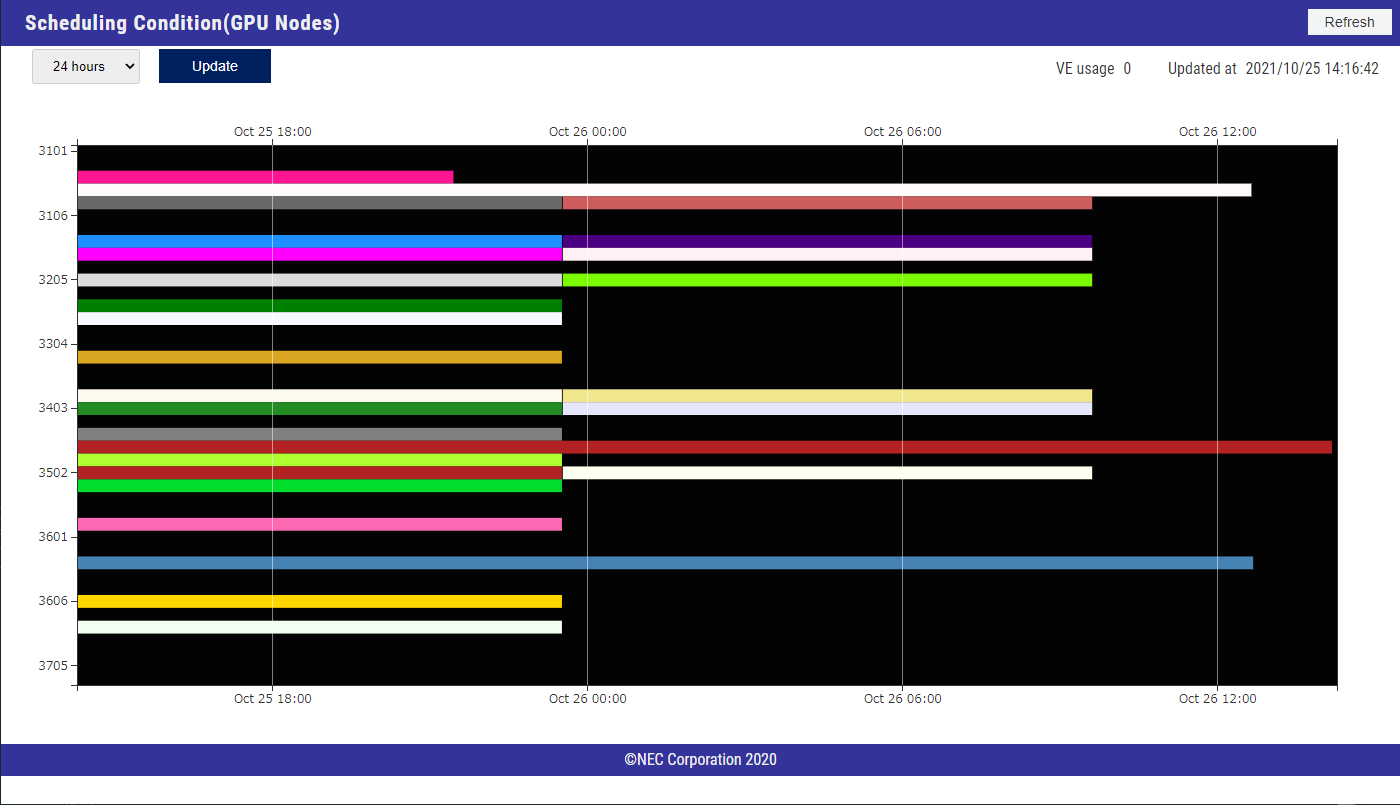
The horizontal axis represents time. The leftmost point is the current time, and moving right shows future times. By default, the status of the past seven days is displayed, but you can change the period using the pull-down menu at the upper left.
The vertical axis represents nodes. The numbers shown are administrative IDs.
Each colored bar represents a job that is running or already assigned, displayed according to the node and time range. Hovering the cursor over a bar shows the request ID.
Usage Information
-
By accessing the following web portal, you can check information such as the number of submitted jobs and node hours used by your group and users.
SQUID User Portal
*Two-factor authentication is required to log in to the SQUID portal. For login and usage instructions, please refer to this manual.*
