
Development of the World's First Ammonia-Fired Burner for Marine Boilers
Author:Kazuto Matsumoto
Affiliation:Volcano Co., Ltd.
Abstract:Our company has been conducting ammonia combustion tests under the “Research and Development Support Program for Growing Small and Medium-sized Enterprises,” with the objective of developing the world’s first burner for marine boilers that uses ammonia as the primary fuel. This project aims to contribute to achieving carbon neutrality by 2050 by developing a burner capable of operating with an ammonia co-firing rate of 80% or higher—an essential technology for realizing zero‑carbon shipping. In the previous fiscal year, we performed combustion simulations to reduce the number of prototyping iterations and to predict exhaust gas composition. We examined calculation conditions and succeeded in running the simulations; however, due to limitations such as relying on a workstation environment, the simulations required an excessive computation time and ultimately failed to converge. In the current fiscal year, we adopted a new simulation software, Front-Flow-Red, and utilized the supercomputing resources of The University of Osaka's D3 Center. Using these enhanced computational capabilities, we achieved convergence of the simulations and conducted comparative evaluations between numerical predictions and experimental measurements. The turbulence model employed in the simulations was Large Eddy Simulation (LES), and the combustion model was the flamelet method. For modeling light oil, Lagrangian particles were introduced, and evaporation was modeled using the non-equilibrium Langmuir–Knudsen evaporation model.
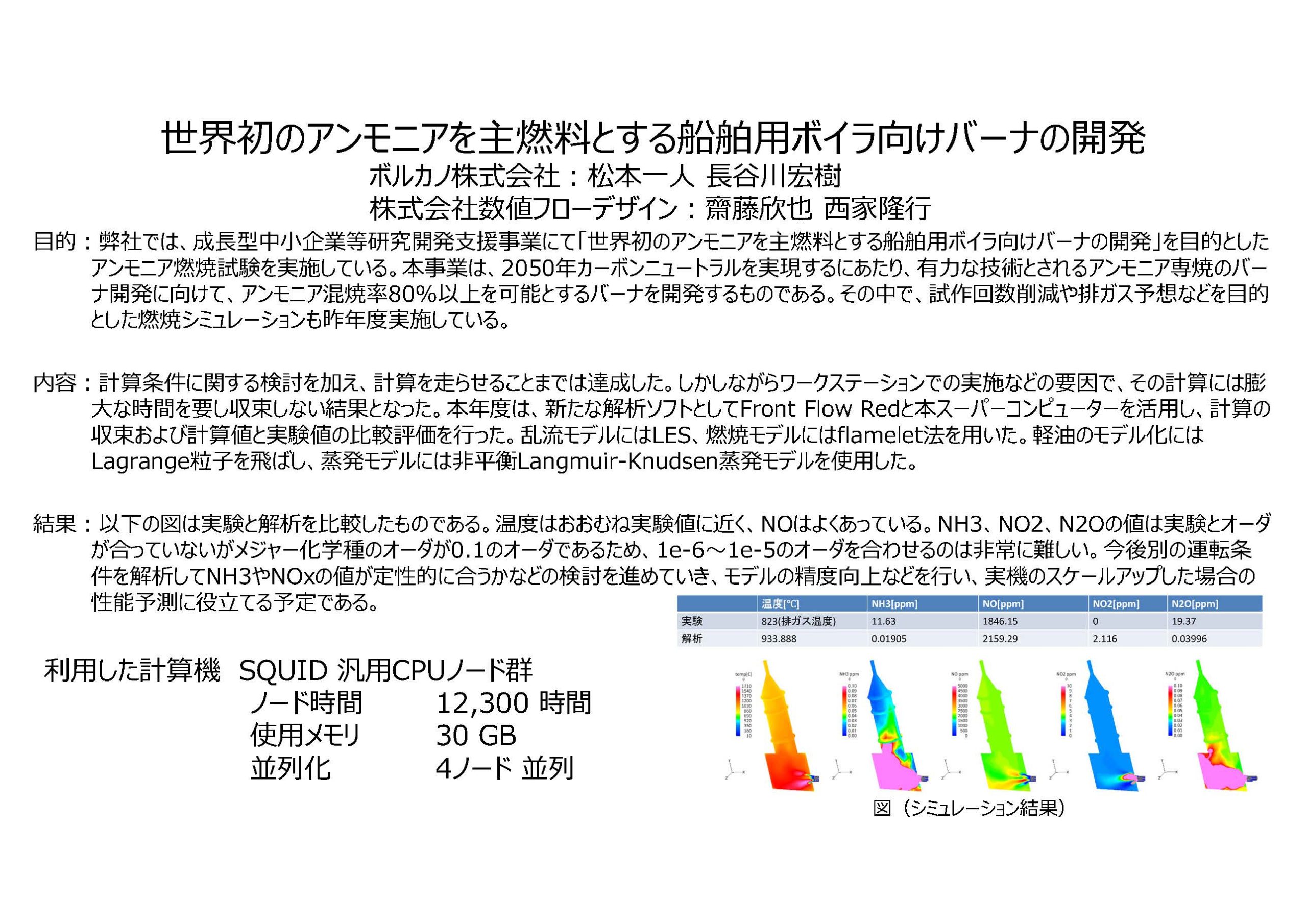
As a result, the predicted temperature field shows good agreement with the experimental measurements, and NO concentrations are also well captured. On the other hand, the predicted values of NH₃, NO₂, and N₂O differ by orders of magnitude from the experimental results. Because major chemical species are on the order of 10⁻¹, achieving quantitative agreement for trace species in the 10⁻⁶ to 10⁻⁵ range is extremely challenging. Going forward, we plan to analyze additional operating conditions to investigate whether the predicted NH₃ and NOₓ distributions show qualitative agreement with experiments. Through these studies, we aim to improve the accuracy of our numerical models and ultimately apply these validated models to performance prediction for full‑scale burner systems.
Affiliation:Volcano Co., Ltd.
Abstract:Our company has been conducting ammonia combustion tests under the “Research and Development Support Program for Growing Small and Medium-sized Enterprises,” with the objective of developing the world’s first burner for marine boilers that uses ammonia as the primary fuel. This project aims to contribute to achieving carbon neutrality by 2050 by developing a burner capable of operating with an ammonia co-firing rate of 80% or higher—an essential technology for realizing zero‑carbon shipping. In the previous fiscal year, we performed combustion simulations to reduce the number of prototyping iterations and to predict exhaust gas composition. We examined calculation conditions and succeeded in running the simulations; however, due to limitations such as relying on a workstation environment, the simulations required an excessive computation time and ultimately failed to converge. In the current fiscal year, we adopted a new simulation software, Front-Flow-Red, and utilized the supercomputing resources of The University of Osaka's D3 Center. Using these enhanced computational capabilities, we achieved convergence of the simulations and conducted comparative evaluations between numerical predictions and experimental measurements. The turbulence model employed in the simulations was Large Eddy Simulation (LES), and the combustion model was the flamelet method. For modeling light oil, Lagrangian particles were introduced, and evaporation was modeled using the non-equilibrium Langmuir–Knudsen evaporation model.
As a result, the predicted temperature field shows good agreement with the experimental measurements, and NO concentrations are also well captured. On the other hand, the predicted values of NH₃, NO₂, and N₂O differ by orders of magnitude from the experimental results. Because major chemical species are on the order of 10⁻¹, achieving quantitative agreement for trace species in the 10⁻⁶ to 10⁻⁵ range is extremely challenging. Going forward, we plan to analyze additional operating conditions to investigate whether the predicted NH₃ and NOₓ distributions show qualitative agreement with experiments. Through these studies, we aim to improve the accuracy of our numerical models and ultimately apply these validated models to performance prediction for full‑scale burner systems.
Posted : March 31,2026
