
Migration mechanisms of second diffusice atom in doubly superionic state
Author:Daisuke Murayama
Affiliation:The University of Osaka
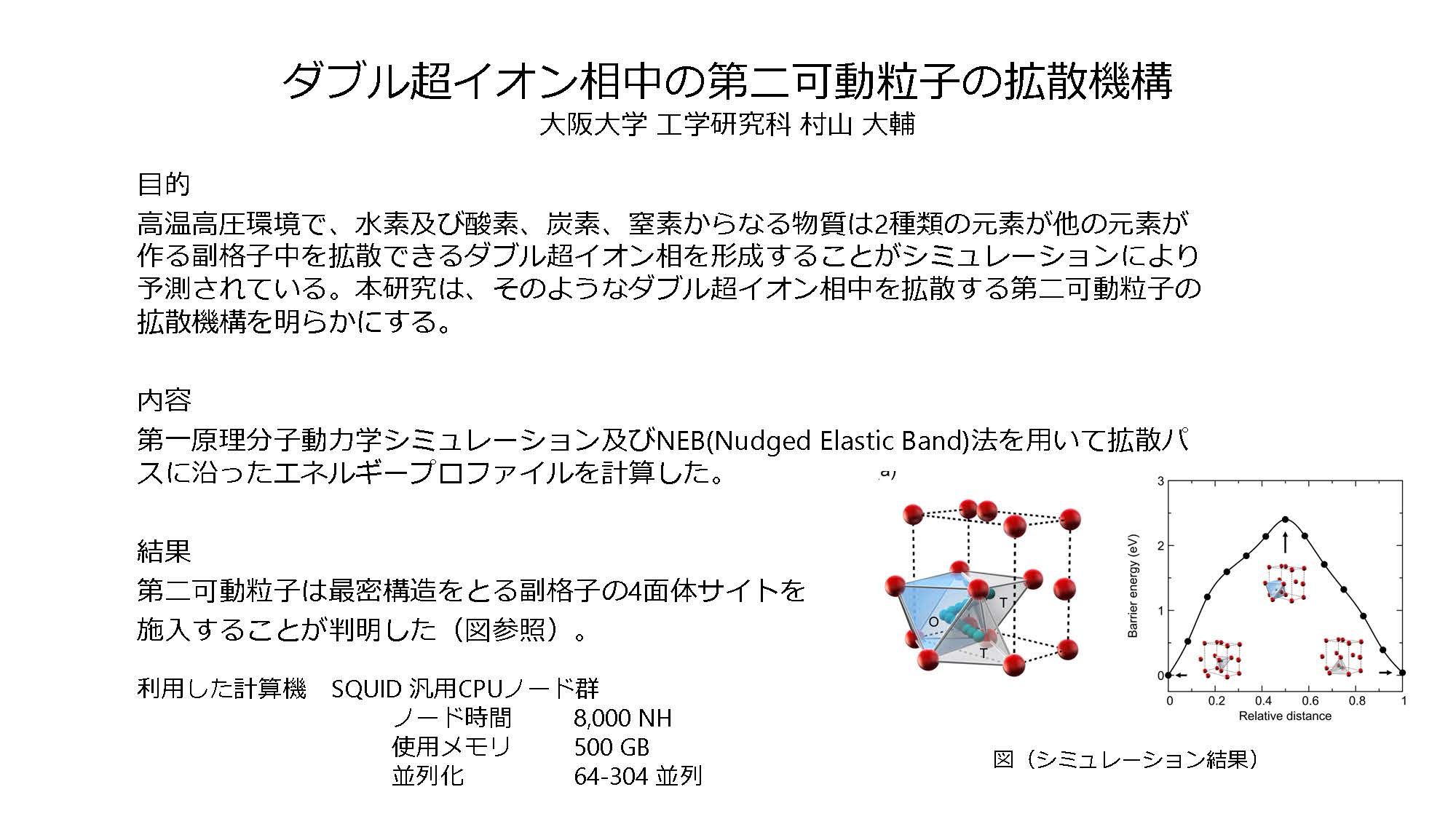
Abstract:Carbon is not expected to participate in the formation of superionic materials because of its separation from hydrogen during the compression of hydrocarbons. Despite this expectation, carbon-bearing superionicity has recently been discovered. Our previous study demonstrated the emergence of a novel superionic phase where both carbon and hydrogen diffuse simultaneously through a fixed oxygen sublattice above ~3000 K and 100 GPa. In this study, we investigated the microscopic diffusion mechanisms of carbon, which is the second diffusive species, in the novel superionic state referred to as double superionicity. Here, we used ab initio molecular dynamics simulations combined with the nudged elastic band method and Mulliken population analysis. Our results showed that carbon occupies the tetrahedral (?) site in the close-packed oxygen sublattices instead of the octahedral site. An analysis of other doubly superionic materials in the C–H–N–O chemical space revealed similar preferences for ?-site occupation by corresponding second diffusive species. This diffusive behavior can be attributed to the covalent-like interactions between the second diffusive and sublattice atoms, suggesting that a close-packed framework is favorable for sustaining double superionicity. The investigated atomic diffusivities provide fundamental insight into superionic materials involving covalent interactions between the second diffusive atoms and the host lattice. Further, our findings can contribute to refining the planetary interior models of C–H–N–O enriched ice giants and guide future investigations into designing novel superionic materials.
Affiliation:The University of Osaka
Abstract:Carbon is not expected to participate in the formation of superionic materials because of its separation from hydrogen during the compression of hydrocarbons. Despite this expectation, carbon-bearing superionicity has recently been discovered. Our previous study demonstrated the emergence of a novel superionic phase where both carbon and hydrogen diffuse simultaneously through a fixed oxygen sublattice above ~3000 K and 100 GPa. In this study, we investigated the microscopic diffusion mechanisms of carbon, which is the second diffusive species, in the novel superionic state referred to as double superionicity. Here, we used ab initio molecular dynamics simulations combined with the nudged elastic band method and Mulliken population analysis. Our results showed that carbon occupies the tetrahedral (?) site in the close-packed oxygen sublattices instead of the octahedral site. An analysis of other doubly superionic materials in the C–H–N–O chemical space revealed similar preferences for ?-site occupation by corresponding second diffusive species. This diffusive behavior can be attributed to the covalent-like interactions between the second diffusive and sublattice atoms, suggesting that a close-packed framework is favorable for sustaining double superionicity. The investigated atomic diffusivities provide fundamental insight into superionic materials involving covalent interactions between the second diffusive atoms and the host lattice. Further, our findings can contribute to refining the planetary interior models of C–H–N–O enriched ice giants and guide future investigations into designing novel superionic materials.
Publication related to this research
(Journal paper)
- Daisuke Murayama, Satoshi Ohmura, Ryosuke Kodama, and Norimasa Ozaki, "Anisotropic hydrogen diffusivity in the superionic phase of C–H–O ternary system in ice giants", Physical Review B, 112, 214108, Dec. 2025.
Posted : March 31,2026
