
電解液中の電子的溶媒和構造研究
氏名:田邉 一郎
所属:立教大学
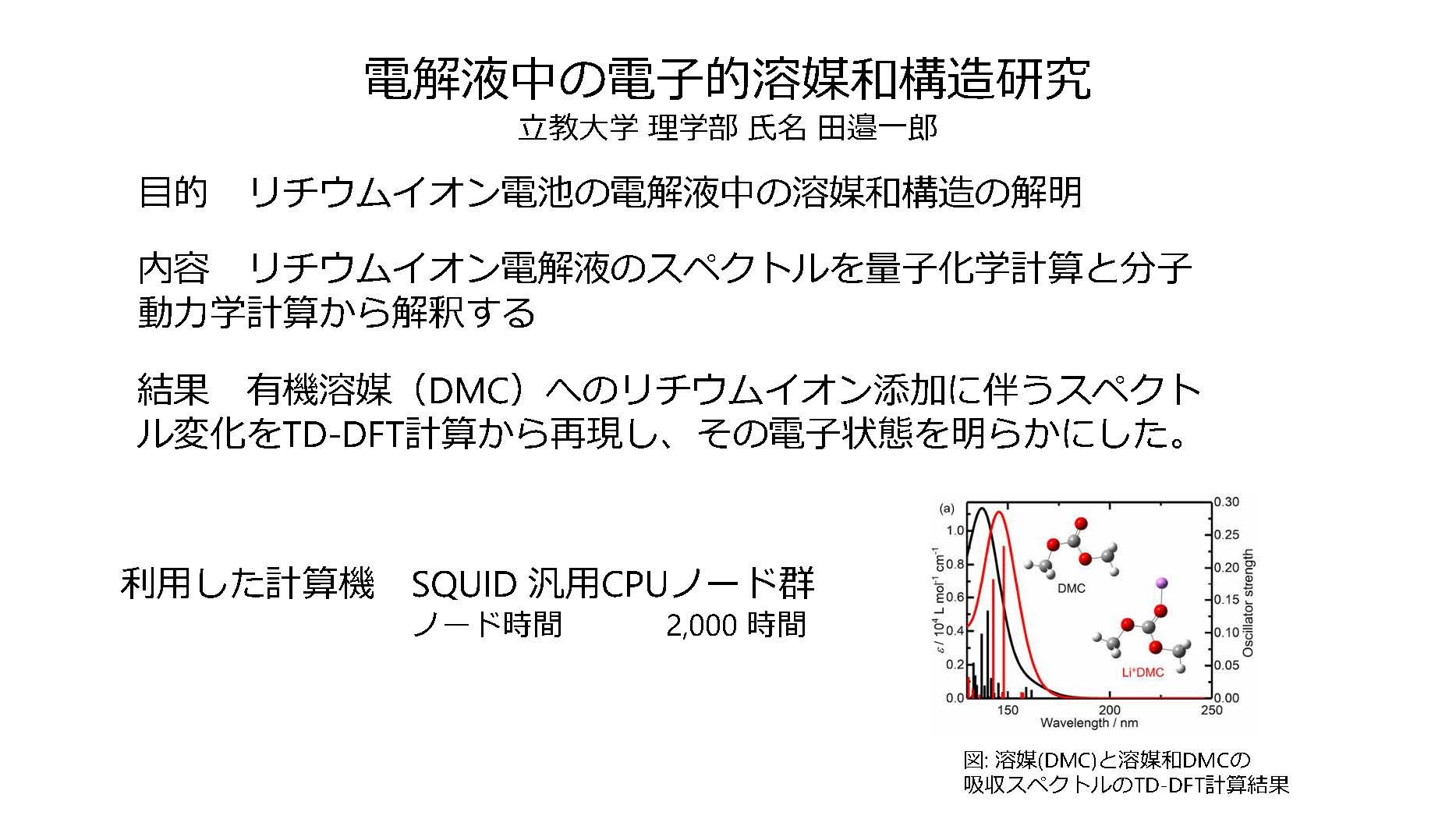
概要:This research project aims to elucidate the "electronic solvation structure" in electrolyte solutions by leveraging a sophisticated computational framework that bridges molecular-scale dynamics and electronic-state transitions. At the core of this study, we will employ a synergistic approach combining Molecular Dynamics (MD) simulations with Time-Dependent Density Functional Theory (TD-DFT). Specifically, MD simulations will be utilized to sample the complex, fluctuating geometric configurations of solvation shells under various salt concentrations and temperatures. From these trajectories, representative clusters will be extracted for high-level TD-DFT calculations to investigate the excited-state electronic structures and the resulting absorption/emission spectra. By quantifying how charge transfer and orbital hybridization evolve within the dynamical solvent environment, we will establish a predictive model for the electrochemical stability and photochemical properties of the electrolyte. Furthermore, we will analyze the transition states of the solvation shell to determine how electronic-level coupling dictates the desolvation kinetics at the electrode interface. This computation-driven paradigm, moving beyond simple static models, will provide essential molecular descriptors for designing next-generation electrolytes with superior rate capabilities and high-voltage durability.
所属:立教大学
概要:This research project aims to elucidate the "electronic solvation structure" in electrolyte solutions by leveraging a sophisticated computational framework that bridges molecular-scale dynamics and electronic-state transitions. At the core of this study, we will employ a synergistic approach combining Molecular Dynamics (MD) simulations with Time-Dependent Density Functional Theory (TD-DFT). Specifically, MD simulations will be utilized to sample the complex, fluctuating geometric configurations of solvation shells under various salt concentrations and temperatures. From these trajectories, representative clusters will be extracted for high-level TD-DFT calculations to investigate the excited-state electronic structures and the resulting absorption/emission spectra. By quantifying how charge transfer and orbital hybridization evolve within the dynamical solvent environment, we will establish a predictive model for the electrochemical stability and photochemical properties of the electrolyte. Furthermore, we will analyze the transition states of the solvation shell to determine how electronic-level coupling dictates the desolvation kinetics at the electrode interface. This computation-driven paradigm, moving beyond simple static models, will provide essential molecular descriptors for designing next-generation electrolytes with superior rate capabilities and high-voltage durability.
Posted : 2026年03月31日
